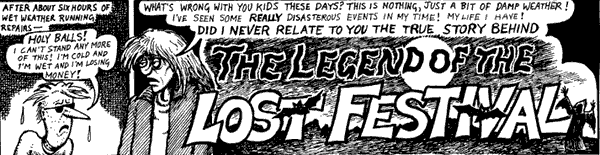
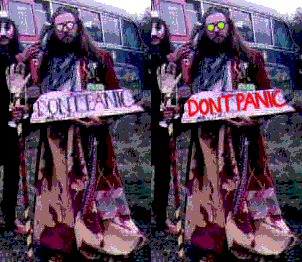
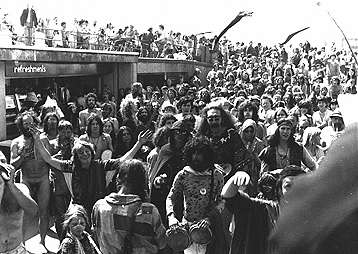
History of the Stonehenge Free Festival :1972-1985.
|
"Could
that many people gather together today with only minimal communal organisation
and such a relatively small amount of trouble but so much pleasure? The question
is irrelevant. They would never allow us."
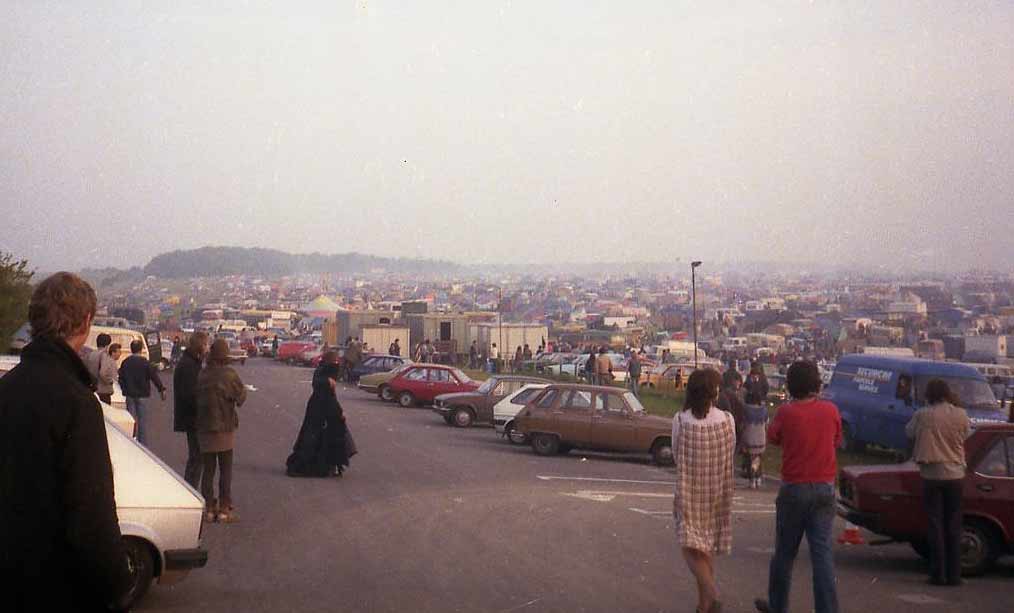
The
festival site in 1984 , a working exercise in collective anarchy....
© Herb
|
The
prehistoric monument at Stonehenge
has long held a fascination for the mystically inclined- and so it was only
natural that those within the counterculture who believed that the ancients
situated their sites at places containing special powers would want to hold
a festival there. After all , at their best -when the music was right , when
the people acted in unison and that rare communal ecstasy came to pass -(
if only fleetingly) festivals could conjure up a heightened awareness . It
was this search for IT that inspired many freaks to take the annual pilgrimage
to the Henge , in addition to the general feeling amongst hard core hippies
that their psychedelic explorations happened to mimic the mindset of the ancients
, it was also an excuse to get down and party hard for ( as the festival progressed
until its demise in 1985) increasingly long amounts of time. So, for a significant
minority, the stones of the Henge became THE place to be to hold the hippie/punk/anarchist/bikie/
traveller ritual of FESTIVAL.
| Of
course , for those who actually managed the site, it was just the opposite-
they saw the festival attendees as a nuisance , despoilers of the monument
(which undoubtedly, some of the less responsible members were ) and
they opposed their presence almost from the outset. This however did
not became a major problem until the 1980s, when the festival began
to burgeon in size. reaching its peak of 30.000 in 1984 . In 1985 the
festival was banned by the loathsome Thatcher goverment and excessively
heavy tactics took place on the road to the stones . This was mostly
instigated by the police and violently inflicted on those who were travelling
to attend the festival , resulting in the infamous "
Battle of The Beanfield ".
A
good account of the busting and violent trashing of the 1985 travellers
convoy enroute to Stonehenge can be found here
External website dead! as well as a detailed account of how the Thatcher government attempted
to supress the traveller movement in the 1980s . More links to other
sites can be found by browsing Chronology which now covers the festival
from 1972-85
|
|
Photo above courtesy of Luke B
go visit his photo site , plenty more nice festy pix
|
|
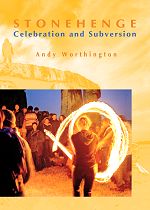
We
are proud of the contribution we have made to Andy Worthington's sociological
history of Stonehenge and the free festival scene in the UK .This
new book gives a fascinating insight into the various countercultural
obsessions with the Stones and provides a variety of new perspectives
to many of the key events surrounding the Henge, such as the Battle
Of The Beanfield and the more recent attempts to hold a celebration
at the Stones during the Solstice.
Find
out more about this great book by clicking on the image on the left
and visit the Heart of Albion Press web site .
|
Lucy Lepchani sent
me this piece which typifies the mystical beliefs and fervour of the
hard core freaks who attended the Henge .
Anarchy,
and it worked. A living model of our deepest, collective, most radical ideals
in action- as give-and-it-comes-back-threefold, the power of creativity,
and joy in simply celebrating our human capacity to enjoy, were the
pillars of our temporary civilisation.
Although it
is more honest to describe the numinous dynamics of Stonehenge Free
Festival in poetic, esoteric language, it won't convey the magic appropriately.
Instead, consider within your minds eye, an assembly of people going
about their laid-back, daily business- and increasing in
numbers daily, and each with their will focussed on the intention
to celebrate summer at it's zenith- to create a living environment
without a hierarchy- to create that as a space where art, music, costume,
flavour, conversation, ideas, surprise, relationship and joy underlied
both daily routines and human rights- to honour traditions and ancestors
we remembered in our psyches and imaginations, rather than via establishment
history and dictates- to manifest at least some of the emerging ideaologies
and practical skills that belonged both to those ancestors, and the
emergent nature-oriented, ecological zeitgeist.
|
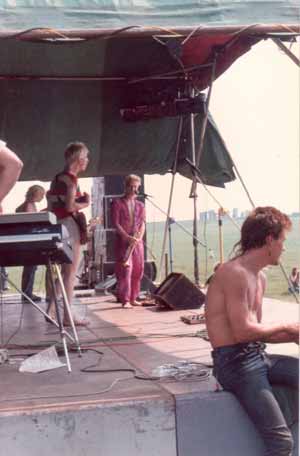
The
Poison Girls Stonehenge 79
Photo
© Big Steve
|
Amongst
the manifest equality and the sensuality there was a sense both of
ownership and belonging, that gave vision to those of us who were
young, and hope and just and juicy reward for those who were pioneers
of the festival, and other festivals, and any freedom-oriented movement
for and by the people. If you are reading this with the wounds
of propaganda about drugs and debauchery blocking your vision,
remember- that actually, these things happen everywhere, and, if they
happen in an environment such as Stonehenge near the solstice, people
are much more likely to make empowered, benevolent, creative decisions
and to carry them through with this energy.
Such
fun and love and strength and laughter and exploration and friends
old and new and exchange of ideas and art and rhythm and initiation
and co-operation as are beyond words. Men and women and children and
youth- all colours and ages.And the sun came up over the stones as
if it were, as it is, the meaning of life.
Chaos
reigned as townies came out for the solstice, and coachloads of city
tourists, alien to our wide-awake eyes with their litter-dropping,
alcohol puking, grubby minds and groping paws. There was never enough
firewood for miles, and woodland got damaged by people who knew nothing
about green wood not burning- the toilet facilities were a disgrace
upon the local authority. Litter got left, although dozens stayed
behind afterwards and cleared tons. When the show was over...
Could
it happen again? Are too many people too far from love, trust and
freedom to recreate it anywhere near as well? Or could we do it better
- learn from our mistakes? The answers, I believe, are the secrets
of our ancestors - ours if we seek them out in all the ancient sacred
places, and realise them.
Lucy
Lepchani

The
encampment 1980, indicates the extent to which the festival
had grown compared to the early years ©
Bodge
|
|
The
festival was a unique social experiment which, for the most part , worked
. It was many things to many people , but ultimately , it was seen by the
government of the day as a threat to entrenched property rights and public
order. A large scale exercise in collective anarchy could not be seen to be
working in practice. The authorities decided to destroy the festival , because
it was too successful. The irony is that a government which was constantly
declaring that it was a bastion of freedom and democracy was at the same time
severely eroding the rights of a significant minority of its citizenry and
alienating them even further from mainstream society .
Any
parallels with present day UK , USA , everywhere ?
A
message to the viewer
The
site has grown a great deal in the past few years and I have expanded/redesigned
various sections several times in an attempt to accommodate the new material.
Here and there this has not been particularly successful regarding easy navigation.
if you come across any sections where it is hard to find stuff, or links are
outdated, let me know and i'll have a go at sorting out the problems .
regards to all
Great
White Shark
Henge
Documents
Henge
History :1972-1984
Any
info to add -? Get in touch -Contact
us
Free
rock festivals of the 70s and 80s
Back
to the main Archive.