For
information on today's festivals see eFestivals.co.uk
The Archive.
Last update March 2019
|
For
information on today's festivals see eFestivals.co.uk |
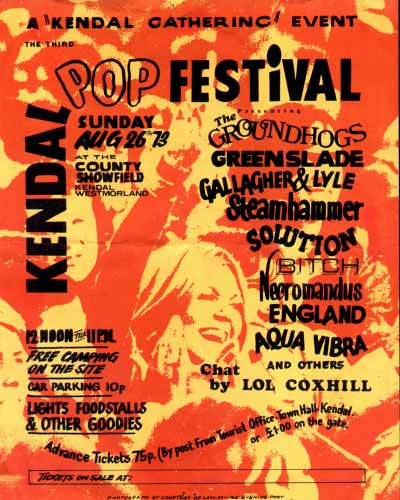
THE KENDAL POP FESTIVAL.
The
Groundhogs,Greenslade , Gallagher and Lyle, Steamhammer, Solution, Bitch,
Brewers Droop,Hackensack ,Stars ,England ,Necromandus ,Cosy Mole ,Aqua
Vibra, Lol Coxhill. |
 |
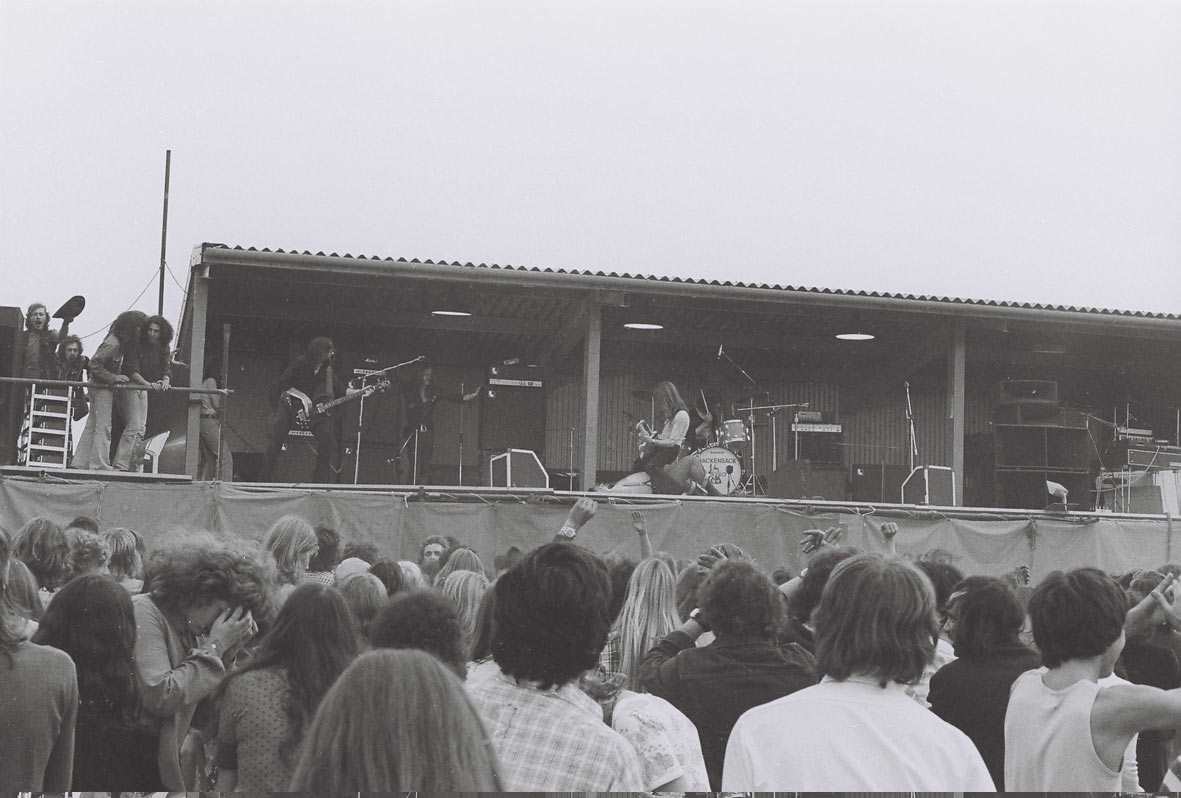
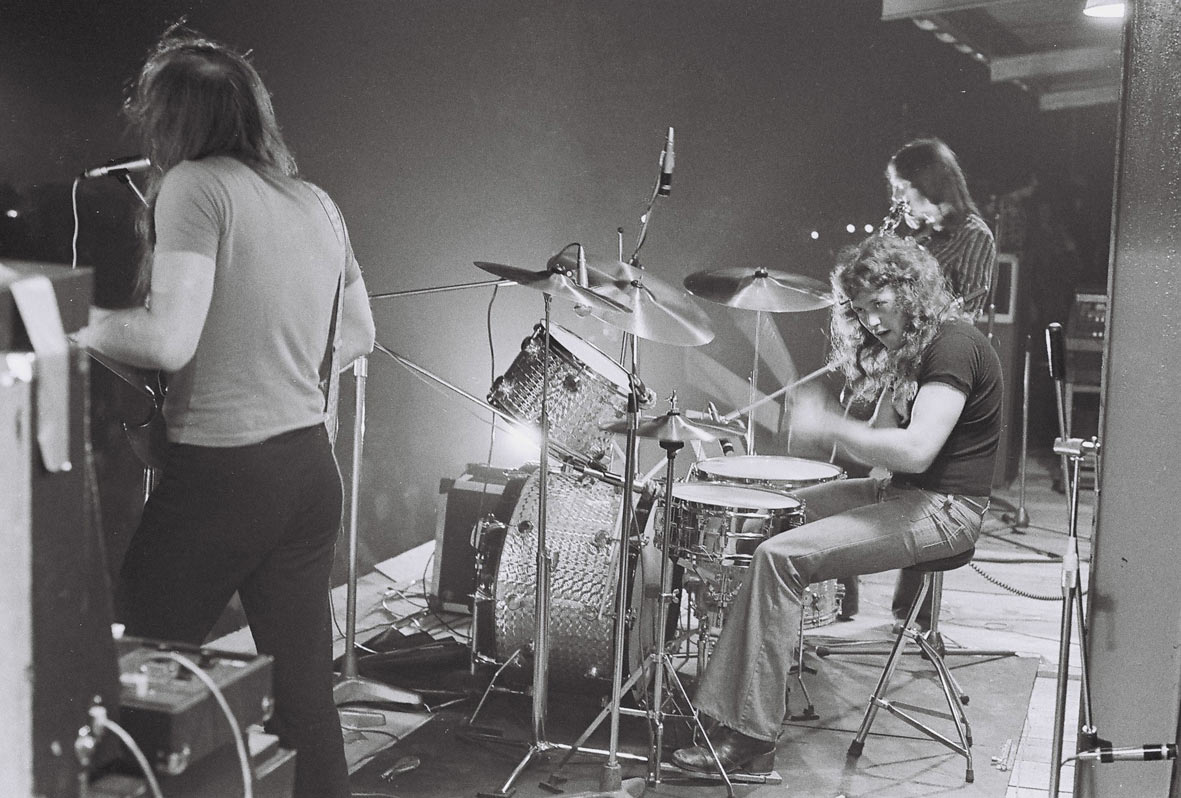
Hackensack wowing it up onstage Kendal Festival 1973 © John Dennis |
| Groundhogs | Greenslade | Hackensack | Audience and angels |
Walking The Walk
In
the early to mid 1970’s, rock or pop festivals reared their multi-faceted
heads all over the country. They ranged from the big, high profile events
like the Knebworth and Bath Festivals to the small, more intimate, gatherings
such as Buxton, and in this particular case, the Kendal Festival in Cumbria.
Kendal is a pleasant, well ordered, typically South Lakes town, an hour’s
drive up the M6, known mainly for its agricultural background and those sickly
white mint cakes.
In
1973, myself and certainly two, possibly three of my friends decided that
a visit to Kendal’s Third Pop Festival would be a good and socially
interesting way to spend a weekend. Kendal is approximately 60 miles from
Fleetwood, our starting point. We did not have the luxury of an available
car to reach our festive destination. The options were public transport, a
bus or a train, or perhaps even “thumbing it”. In those days the
idea of “getting on the road” or “thumbing it” were
still considered to be romantic, idealistic things to do in some kind of perverse
way. Nowadays, hitchhiking would be considered a very good way to get your
throat cut in a hurry. We were not the type of people to follow trends; we
just wanted to make social or political statements, even about fairly simple,
innocuous things like getting from A to B. Either that, or we were just plain
awkward, or even more likely, a mixture of both. So we decided to walk. After
all it was only about 60 miles. We reasoned, if Jack Kerouac, Neil Cassidy
or the Merry Pranksters (Californian counter-culture icons, and for a time,
role models) could do things, seemingly crazy, illogical things, and still
manage to get some intangible satisfaction from it, why couldn’t we?
We read the books; we talked the talk, now we were trying to walk the walk.
The festival itself was a one-day affair, which was held at the show ground where the agricultural fraternity held their annual shows. Some people, less charitable than myself, might have said, “How appropriate”! We figured that a day “on the road” to reach the site would be more than adequate considering the distance involved. So, on the Saturday before the festival we embarked on the Fleetwood to Knott End ferry for the first stage of our “Tour de Trance”. We disembarked on the Knott End slipway roughly about mid-morning and felt quite “at one” with the universe. It was sunny, we were focussed on “our mission”, and we hit the road in front of us full of enthusiasm and positive thoughts about the weekend ahead. The first hour or so of walking was thoroughly enjoyable, taking in the sunshine, the surrounding rural idyll, and of course the good company. As we moved along the coastal strip and then on to Cockerham Sands, the romantic visions of Jack Kerouac and his nomad associates started to subside into the more realistic problems of sore feet and short tempers (and quite possibly mild depression). The glorious road trip was quickly turning into a drudge and all we really wanted to do was to reach Lancaster and catch an unromantic, totally rational, not psychedelic, ordinary red coloured service bus to Kendal.We eventually reached the ancient City of Lancaster, a place I’ve always had a lot of affection for, and made straight for the bus station. At the bus station there were more alternative types waiting for the slow bus north.The weather earlier in the day had been wonderful, bright and sunny mirroring our mood at that point. Now the sky was grey, the chances of rain were high and the joyous optimism that had lead us into this daft "let’s walk there" frame of mind, started to change to "what are we doing here"?
This event, being over thirty years ago, has over-worked the old memory cells and a lot of what did happen, certainly the minutiae, has long been erased or at least placed somewhere in my memory bank for safe keeping, and now I can’t find it. Life’s like that isn’t it. However, I do seem to recall we arrived at the site on the Saturday night and (to the best of my recollection) we didn’t have a tent, so we just “crashed out” where we could and embraced the morning dew (there’s a song in there somewhere).
On the Sunday morning we surveyed the festival site. Unlike a lot of present day festivals that have multi-stage presentations (some even in marquees), the festival at Kendal was definitely "old school" having a single stage at the front of the showground. The camping area was at the opposite end of the site, facing the stage, and the audience were in the middle of these two entities like a human sandwich. We soon met up with two other friends from the Fylde Coast, Malcolm "Akky"Atkinson and John Caley, who had had a more sedate journey up to Kendal by means of an old motorcycle combination (bike and sidecar). We must have looked like a real motley crew. There was "Akky" and John Caley looking like something out a 60’s biker movie, knackered, stressed old jeans, well- worn leathers, long hair and beards etc. Myself and my fellow travellers, Jake Bywater, and Dex Haslam were dressed in a mixture of ex U.S.Army surplus combat jackets, patched up Levi’s, an "altered' Trilby hat and I believe, a German Army tunic from the second world war.
We
had noticed, on our reconnaissance missions around the festival site, two
quite large groups of parked motorcycles. The first group had relatively clean,
shiny looking machines, full of chrome fenders and fuel tanks. These particular
bikes belonged to the South Yorkshire Chapter of the Hell’s Angels.
There were approximately twelve to fifteen of these gentlemen and their respective
machines. They seemed to mostly keep themselves to themselves, not over-friendly
but not threatening either. The other group of motorcycles belonged to another
chapter of the Hell’s Angels organisation; the Darlington Chapter from
County Durham. It was this second group we first came into contact with on
that Sunday. In retrospect, thinking about how we looked, how “Akky”
and John looked, the old motorcycle combo, finished off sartorially by the
WW2 German tunic, they must have thought we were kindred spirits.
A couple of the Darlington Angel’s came across and offered a bottle
of Scotch one of them was cradling like a mother cradles her young born. This
was about ten o’clock in the morning, but one didn’t want to appear
discourteous, so we imbibed a tot. Another one of the Angel’s associates
took a "shine" to Dex’s cosmic trilby. We were thinking, "you’ll
never see that again", but he did, albeit with a disappointed glance.
The Angel obviously had a code; a code of the road, maybe, maybe not.
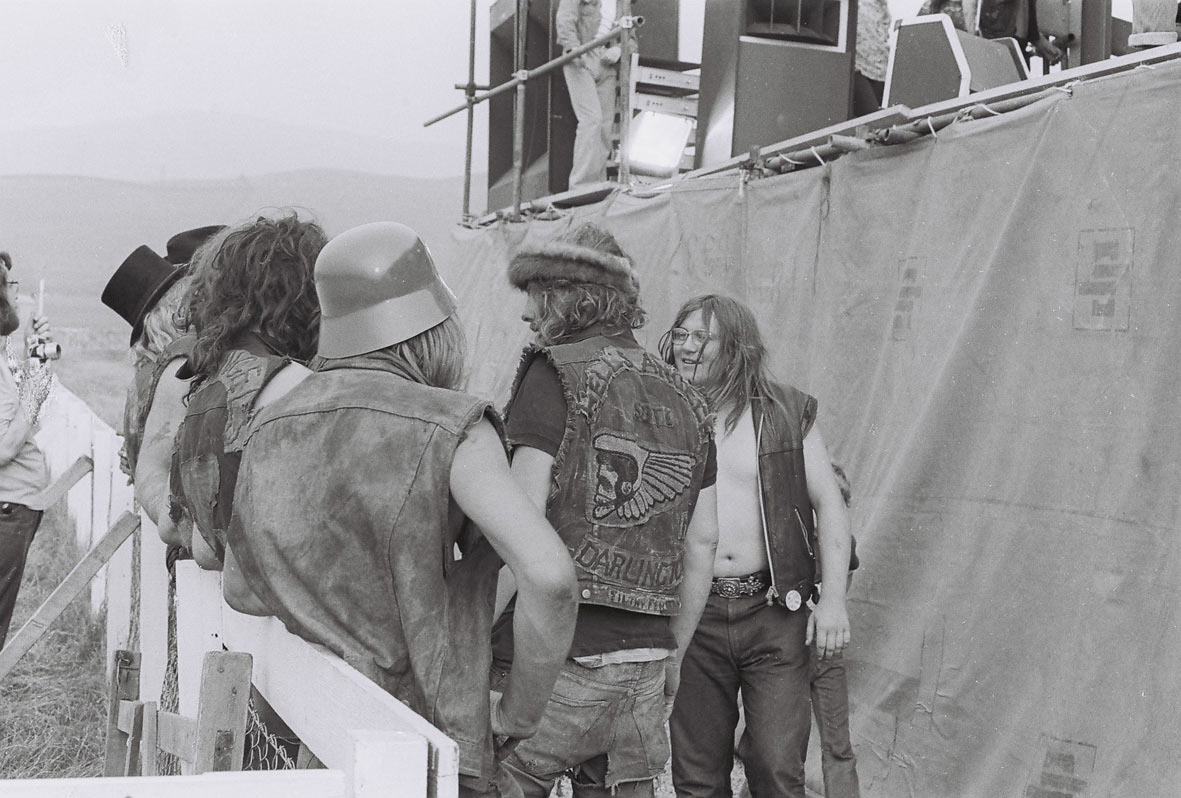
We didn’t have any more direct contact with the Darlington Angel’s, but we did witness some rather strange and provocative behaviour from these guys later on that day. To backtrack momentarily, these Darlington Hells Angels looked the part. They were the real thing, authentic, slightly threatening, not in an overt way but subliminally. They wore the traditional Hells Angel uniform in most cases. Several separate pairs of jeans worn over each other, like a Russian Doll type of effect, tattered and filthy and proud of it. Their colours were worn on the back of sawn off jackets that may have been leather, you couldn’t really tell. The emblems emblazoned on the back of their jackets were all slightly different which indicated the owners "rank" or position within the group, a bit like the Freemasons really. And in general they just looked wild, and I mean wild. There was one guy who must have been six feet five inches tall, and approximately half that in circumference. He was a man-mountain who resembled the character "Mongo" in Mel Brooke’s classic pastiche of the western movie genre, “Blazing Saddles”. There was another guy who had very long, dirty blonde hair, a long goatee beard and wore an Abraham Lincoln style "stove pipe" hat. They looked, for all the world like support actors in a 1960’s Roger Corman film about “outlaw” bike gangs in California, you know the exploitative films like “The Wild Angels” or the more recent "Surf Nazi’s Must Die".
The Darlington Angels © John Dennis |
courtesy June Reed |
The other Hells Angel’s grouping, South Yorkshire Chapter, looked sedate by comparison. It was interesting also that the two groups, supposed "brothers" in the Hells Angel’s organisation, didn’t mix at all socially. The only conclusion you could reasonably draw from this situation was that the Hells Angel’s, just like any other social grouping, had a hierarchy, a social pecking order. It would appear, to me at any rate, that the Darlington Chapter was either an older chapter and more established in the Angel hierarchy and didn’t have to mix with "Johnny come lately’s" , or conversely that the South Yorkshire Chapter was an "unofficial" group, not sanctioned by the central organising chapter of the Hells Angel’s, the Oakland Chapter in California. These are my suppositions not fact. (the South Yorks Angels may have been members of a group called "the Druids " who apparently masqueraded as Angels, can anyone confirm /deny? ed)
Anyway, that’s the sociology bit, what about the bands? Frankly, until extremely recently I had forgotten completely about this sociological experiment, but my good friend and fellow archivist, Jake Bywater leant me some research material to aid me in the completion of this book and that’s what brought back my memory (at least partially). One of the bands that appeared were called HACKENSACK, their name derived from a borough of either New York or New Jersey in the United States. They had a recording contract with Polydor Records I believe at the time, and did release a couple of albums, one of which did have a good cover design. As for the music, well I can’t remember a thing about their set. The seventies were a bit like the sixties in as much as the saying goes “If you can remember them (the 60’s/70’s) you weren’t there. This is not strictly true, but is not far off the mark.
Another act that appeared that day was GREENSLADE. They were a keyboard-oriented band like many British bands of that era, but unlike a lot of their contemporaries who had pseudo-classical influences (and pretensions) in their music, Greenslade had a definite jazzy feel to their music, in the same way that later incarnation of the Anglo-French band GONG had in the late 1970’s when Pierre Moelern had control of the band’s output.
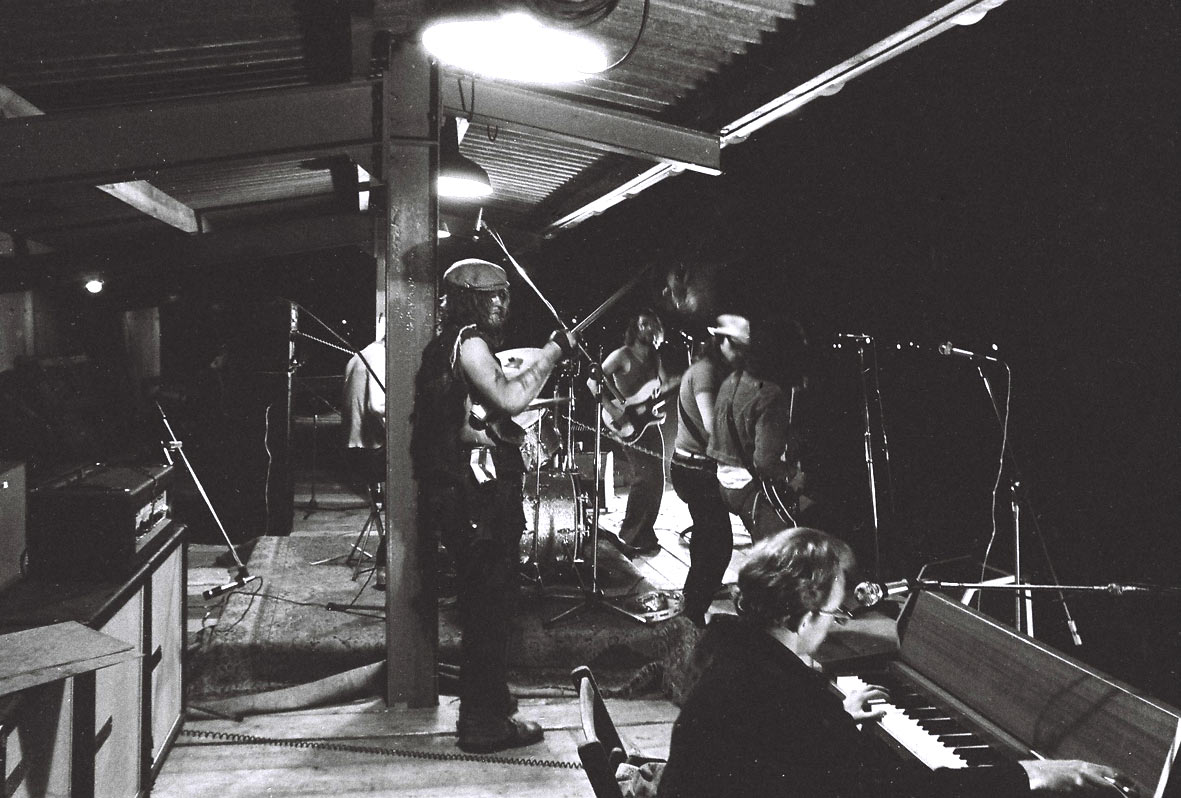
Greenslade © John Dennis |
The only performance at the festival that I have anything approaching clarity of was the set performed by The GROUNDHOGS. The band has been around since the mid-sixties, and still retains to this day, a core that is dominated by the blues. However, in the early to mid seventies their music took on other dimensions and they flirted with experimental (for its time) guitar based acid-rock blues. One particular song that illustrates this move into other musical areas was "Cherry Red", which is also the source of the independent record company of the same name. To return to their festival performance, their brand of fractious acid-rock blues had inspired the Darlington Hells Angels to engage in wild fits of exuberant dancing at the front of the stage. There was a strange atmosphere brewing that indicated that someone or something, sooner or later, was going to kick off. Earlier in the afternoon the Darlington Angels had held a bizarre procession right through the middle of the largely seated, and substantial, audience. The “Man Mountain”, the six feet five inch Angel who looked like "Mongo" from Blazing Saddles I described earlier in this piece led this bizarre and provocative procession. He was at the front of his “comrades” with an old railway sleeper slung over his shoulder that had a World War Two Nazi flag attached to the end of the wooden sleeper.
The Groundhogs © John Dennis |
" Bloody Hell" we thought, this is going to turn out to be like Altamont. The big free concert held in California in 1969. To cut a long story short, there was an incident that resulted in the death of a concertgoer at the hands of the Hells Angels. The Angels maintained that they were doing their job in protecting the Stones and keeping general order, but to a lot of observers it was just a riot by beer fuelled, lawless bikers.
Fortunately, Kendal didn’t become Altamont part two. Nonetheless as night fell, fires did start to appear from the campsite area. These fires however, were not just confined to campfires themselves, some of the tents that belonged to the festival-goers also went up in smoke and the general atmosphere of impending doom continued to tale its toll. I seem to think that we left the festival site earlier than expected. As Neil, the character from the "Young One’s" would have said, "Bummer"!
Mike Wheeler
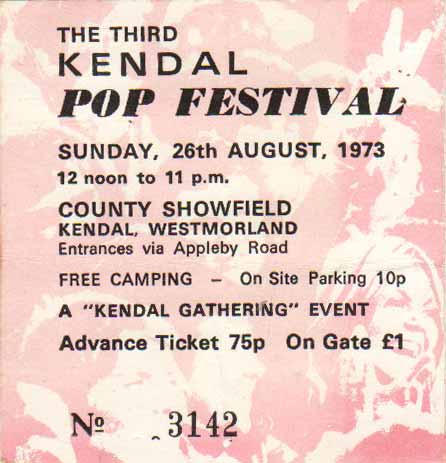
Ticket courtesy June Reed |
Back
in 1973, I had reached the age of 16 and had already decided that my life
required three essential ingredients: sex, drugs and rock and roll. So
when my school friend Alan offered me a ticket to the Kendall pop festival
I jumped at the chance to enjoy at least the last of my three stated ambitions.
In fact, although I did not yet know it, I was to experience all three
(to a greater or lesser degree!) My parents were predictably cautious about me going to any kind of pop festival. But my older brother had already been to one in Yorkshire and in the early 70's it was becoming an expectation of most teenagers. What made this one 'safer' was that Alan's dad was going to drive us there. It is interesting to note how selective our memory can be for events of nearly 40 years ago. I remember leaving the site to go into Kendal to get some food. The Hells Angels were present in large numbers and I remember hearing (I didn't witness it myself) that a chair had been thrown through a pub window. There was certainly an air of excitement, but also a brooding menace about their very visible presence both in the town and at the festival site. Lol Coxhill was amusing and did his thing playing two saxophones at the same time. It was fun, but it was guitars I wanted to hear! The highlight of the staged music for me, despite the anticipation of bands we already knew, like The Groundhogs and Greenslade, was a song called "Northern Girl" by Hackensack. I still clearly remember the glorious sound of the rhythm guitar (was it a 12 string?) and the soaring lead guitar solo which I remember as containing some low, slow and soulful notes. Somehow that sound became fixed in my brain and ever since then I have tried to find a way to recreate that unique and powerful experience. I think an essential component of the sound was the way it echoed off the trees behind us to create a complex audio landscape. When the wind blew (as it did!) there would sometimes be an eerie "out of phase" effect between the speaker stacks at each side of the stage. For a 16 year old who had been playing guitar half my life, and who dreamed of headlining the next Woodstock or Isle of White festival, but who has never before experienced the sound of a load outdoor rock gig - this was about as exciting as it could get! I would really love to get to hear that Hackensack track again to identify what it was that so captured my attention. |
|
Later in the evening, after the music on the main stage had finished I was with a group sitting around a camp fire. A steel string guitar was passed around, followed by a joint and later, a swig of whiskey. I got lost in the sound of the guitar and remember it had a nice low action and light strings which I could bend. We all stayed up playing, smoking and chatting until very late. Even now, my favourite venue is still to play around a camp fire under the stars at silly o’clock in the morning.
So that was the extent of the drugs and rock and roll. The sex was perhaps
a little less fulfilling(!) - I remember walking around the back of
the site and being quite shocked and a little excited to see a couple
having sex close to the perimeter fence. They were blissfully unaware
of everyone else and I moved away rapidly. |
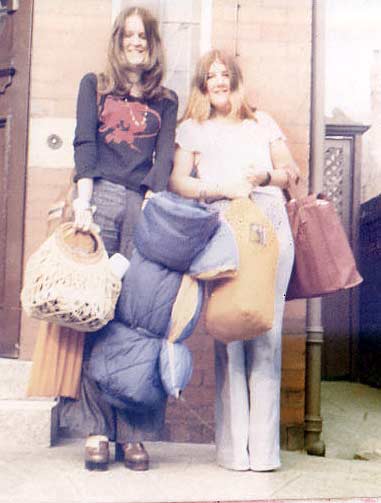
Lyne and June , all ready to go to the festival .... |
Hiya, My friend, Lynn, on the left, recalled that the mikes stopped working when the Groundhogs came on so we were left without sound for a while, but they were good. When we came back to our tent, we found that a pile of hells angels had very kindly splattered about a dozen or so tents, including ours, snapping the ridge poles, making it impossible to be used. We found some friends, dragged what was left of our tent near them and slept under the stars. We were freezing. The bikers treated us to an early morning ride-past of stunts galore- they were still off their faces from the previous day- but isn't that what fests are about?! I
also remember there were two kids in a nearby tent. I found out they
were 11 & 13 yrs. The younger or the two started going mental,
but his friend wasn't phased by it - he'd had some bad acid apparently.
There weren't that many folk there- from what I can remember- but
I recall reading in the Blackpool Evening Gazette after I'd been to
The Picnic at Blackbush that, out of nearly 250,000 people attending,
there were only 33 dope related arrests. It was a very mellow day.
I don't know, maybe someone took advantage of the kid in Kendal because
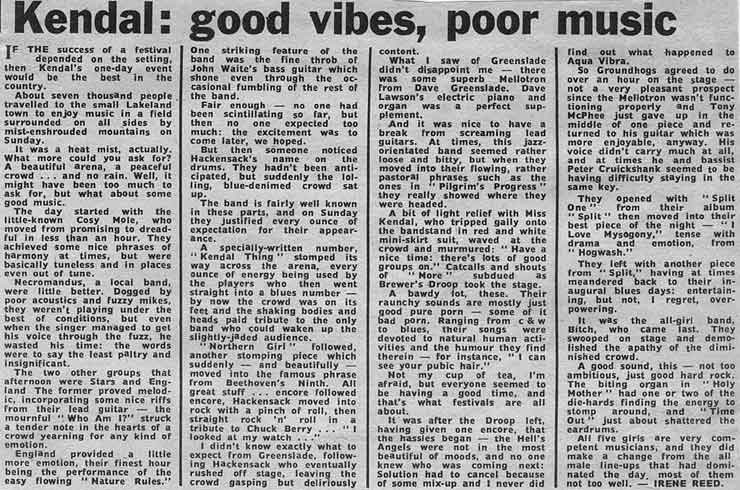
of his age. Thanks to Gary Bodenham and June Reed for the cutting, ticket and advert .
|
|
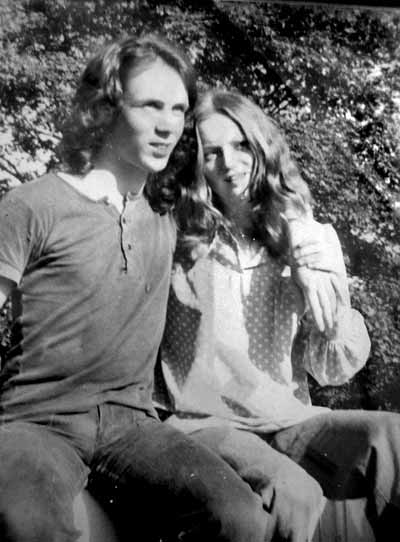
Hi Just found your site and saw the link asking for any more information on the day. I was looking for the actual date the concert took place. I went with my friend Maracelle who was Spanish from 12 noon until about 5 ish when I went home to get changed for the night music. I went back into Kendal with my friend Maureen and we went to the George and Dragon in Kendal which was one of the popular pubs. In there I noticed this male who walked in with a group of what can only be called good looking hippies. I was attracted to him at once but of course only being young was too afraid to go up to him. He wolfed down a hamburger and a pint quicker than anyone else I have ever seen standing near the bar.We decided to follow them as they were going to the pop concert as well. We shadowed them and talked to some and one of them was making clicking noises. We got to the field and sat near them. Then somehow we started talking and it was like magic what happened as Mike made his way towards me and that was it....we are still together today and will be celebrating our 35th wedding anniversary in November. We have joked through the years that we will go and sit in Aldi car park (as that has been built on the spot we first got talking )on the 26th August with a bottle of bubbly. We spent our courting days on a Friday and sometimes a Saturday night in the George and Dragon always sitting in the same place. We have one Daughter and two Grandsons and are retired now but the story of us meeting at Kendal Pop festival has been told quite a lot over the years. Oh and as for the music atmosphere and crowds I cant praise the day enough. I did not see any trouble at all.The music was good and I remember it was pleasantly warm and sunny and I danced a lot. My Grandmother lived in one of the four houses at the Milk Marketing Board and she came and stood and listened to the music bringing us sandwiches and cakes passing them over the wall. There was no security as I remember and all we got was a stamp on our wrist when we wanted to go in and out. I seem to have had rose coloured glasses on that day but as a 17 year old it was quite a big event and I am certainly glad it happened. I do remember some rockers on bikes at the Duke of Cumberland but they were not making trouble just having fun. I dont have any pictures from the pop festival but have attached one of us in 1974, looking the same as the previous year I think.Hope you enjoyed my memories. Het Farrington. Aged 55 and should know better !!
|
Mike and Het , circa 1974.... |
| Groundhogs | Greenslade | Hackensack | Audience and angels |
Do you have any extra information re this festival? Contact us if you can help.